

Email A

Hello,
You may have heard by now that the markets experienced their biggest drop on Tuesday since June 2020. The S&P 500 fell 4.3% and the techheavy Nasdaq composite dropped more than 5%.1,2
What happened?
Persistent inflation is continuing to influence investor sentiment. This is indicated by the market’s drop following Tuesday’s release of the government’s August Consumer Price Index.3
Not only are prices remaining on the rise (food is up 11.4% year-overyear), but all eyes now fall on the Federal Reserve to see what their response may be. The Fed’s primary weapon in fighting high inflation is to increase interest rates. But this requires a careful balancing act.3
Raising rates may curb inflation, but it could also push the economy closer toward a recession. Of course, the opposite is possible as well. Not acting aggressively enough would likely mean prolonged periods of high inflation.
This situation, which has been exacerbated by August’s CPI report, makes traders nervous. Nervous traders may be quick to sell stocks, as we saw today. Short-term ups and downs can be emotional to watch as an investor.
But working with a trusted financial partner allows you to see past the news stories and focus on what really matters — your long-term goals.
If you’re concerned about what you’ve seen on the news or in the markets this week, don’t hesitate to reach out. Our goal is to help guide you through these tough times and focus on a brighter future.
All the best,
1. Money.CNN.com, September 13, 2022
2. The S&P 500 Composite Index is an unmanaged index that is considered representative of the overall U.S. stock market. The Nasdaq Composite Index is an unmanaged index that is considered representative of small-capitalization companies. Index performance is not indicative of the past performance of a particular investment. Past performance does not guarantee future results. Individuals cannot invest directly in an index. The return and principal value of stock prices will fluctuate as market conditions change. And shares, when sold, may be worth more or less than their original cost
3. BLS.gov, September 13, 2022
James Mitchell
james.mitchell@faulknermediagroup.com
(555) 555-5555
J. Mitchell & Associates

Email B
Hello,
Believe me, everyone on Wall Street wants inflation to go away, or at least shrink back to below 2%, a level we enjoyed not so long ago.
But Tuesday's Consumer Price Index report showed it might be some time before we see 2% again. Consumer prices ticked slightly lower in August, but not as much as what Wall Street wanted. Economists, pointing out that gasoline prices dropped in the past month, made bold predictions for August inflation. Too bold, as it turned out.
Stocks got clobbered, and bonds didn’t fare much better. The inflation report showed that higher food, shelter, and medical services costs were to blame. Higher costs in those areas indicate inflation could be more persistent and entrenched than we thought.1
So now the question is, “What will the Fed do at its upcoming meeting?” In the chart below, the green highlights show the most likely outcomes for the next several Fed meetings, according to the CME Group. Keep in mind that in early September, the CME Group’s indicator said smaller increases were possible. But no more.
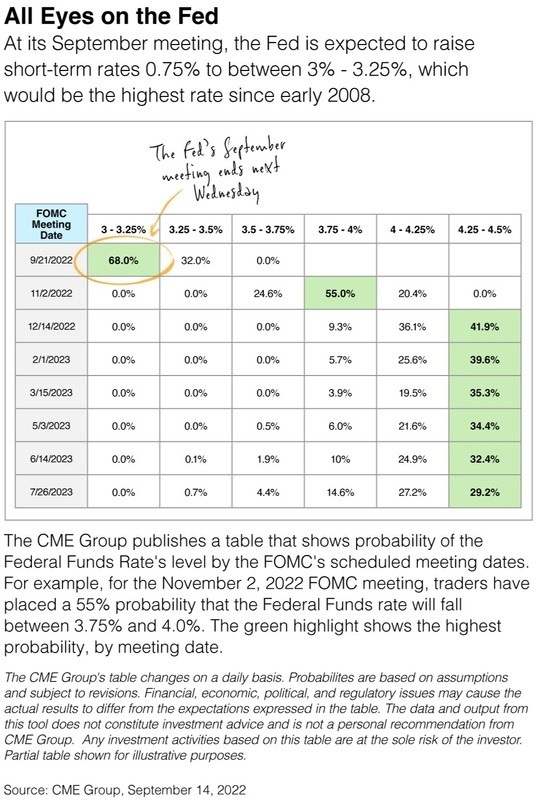
All too often this year, I haven’t had great news to pass along about the markets. But I want to assure you that I’m committed to staying on top of the news in good times, bad times, and in-between times.
If Tuesday's drop raised some new concerns, please give me a call. Thanks for your trust.
1. BLS.gov, September 13, 2022
The S&P 500 Composite Index is an unmanaged index that is considered representative of the overall U.S. stock market. Index performance is not indicative of the past performance of a particular investment. Past performance does not guarantee future results. Individuals cannot invest directly in an index. The return and principal value of stock prices will fluctuate as market conditions change. And shares, when sold, may be worth more or less than their original cost.
James Mitchell
james.mitchell@faulknermediagroup.com
(555) 555-5555
J. Mitchell & Associates